The Show Must Go On: The Bull Case for Enterprise AI Adoption

This is the most important question for the AI industry right now:
Can AI capability create economic value fast enough to justify the capital being deployed ahead of it?
That’s it. Everything else, including the debates over open source vs closed source models, the capability curves and scaling laws, the regulatory capture agendas, and the job displacement theories, is all downstream of this core question. Because if the revenue doesn’t show up in time, these are all moot points.
The AI bear case generally centers on the lack of ROI from enterprise AI spend. McKinsey’s State of AI research has roughly 88% of companies reporting AI adoption in some form, while only about 6% are capturing meaningful EBIT impact. That doesn’t sound very encouraging.
So companies are spending on AI, yet the productivity gains are not showing up in a meaningful enough way. Therefore it’s logical to conclude that if enterprises are not finding ROI, the budgets will get cut, the token demand will dry up, and the whole buildout gets questioned.
My contrarian take is that the numbers are right but the conclusion is wrong.
If you look at enterprise AI adoption through a game theory lens, the lack of ROI is not the angle that concludes we’re headed for trouble. It is exactly what the equilibrium predicts.
Most companies are playing a game where the payoff for the average player is, by design, approximately zero, but where the rules make continued heavy investment the only rational move anyway.
Let’s sit on that point for a minute because it’s the most important and central argument of this entire piece.
To be more clear - most enterprises MUST continue to spend on AI, regardless of whether early efforts produce ROI or not, because not spending has a worse expected outcome.
This may sound counter-intuitive, but I’ll take you through the thinking and we’ll touch on some common game theory concepts like the Red Queen race, the prisoner’s dilemma, the innovator’s dilemma, and the R&D arms race to show why the optimal move is almost always continued investment.
I will then break it down further and show how specific moves and payouts differ depending on two properties of your industry:
-
Whether AI advantages compound
-
What AI does to your revenue pool
Once you locate your industry on those two axes, you will understand why the average adopter is not seeing ROI, and more importantly, you’ll see why nobody gets to stop investing in AI regardless of ROI.
This is a strategy piece, but not from an academic point of view - in the end you will be able to map your company’s position, understand the rules of engagement, and know your optimal move.
Part One builds out the game theory thesis. Part Two runs it across four industry archetypes. The short conclusion is that in three of the four, the optimal play is more investment, not less.
Part One: The AI investment game
Three moves on the board
Note: this is a simplification of the strategy which boils down every enterprise’s decision to three moves. In reality this happens along a gradient, but the simplification allows us to see the optimal moves based on expected payoffs. It is illustrative, but also directional.
Enterprises looking at AI have 3 moves to play:
-
Watch. Make no material AI investment. Observe rivals, let them pay the tuition of early experimentation, and preserve the option to move later. The bet here is that either AI underdelivers and you saved the money, or it delivers and you can fast-follow before the gap becomes structural.
-
Incrementally adopt. Adopt AI as a productivity tool. Copilots, coding assistants, workflow acceleration. Treat it the way enterprises treated spreadsheets or email - a horizontal capability that makes existing work faster. Modest investment, modest change, modest risk.
-
Transform. Rebuild the operating model around AI. Agents embedded in core workflows, processes redesigned rather than accelerated, cost structures and sometimes pricing rebuilt on the assumption that intelligence is abundant and cheap. High investment, high organizational risk, and a payoff that depends entirely on whether your industry rewards it.
Consultancies love to map adoption of emerging technology along maturity curves and would plot these moves on the map as if you’re supposed to follow some progression. But that assumes this is a single player game - that your objective is to progress your way to the desired spot on the maturity map. Don’t fall for this garbage, it’s just a way to sell you services.
In the AI investment game, each firm in a competitive market picks one of these moves, and the payoff to each move depends on what rivals choose.
What matters here is the interdependence between players - AI adoption is a multi-player game and therefore we need to look at it through a game theory lens rather than a maturity model.
Ante up: why everyone pays regardless of ROI
Start with the case that is most common in most industries right now - everyone plays Incremental.
The outcome is well understood in strategy theory yet largely ignored in the discourse. Michael Porter’s classic essay “What Is Strategy?” drew the distinction 30 years ago between operational effectiveness and strategy.
Operational effectiveness means performing similar activities better than rivals. Strategy means performing different activities, or similar activities in a different way.
Operational effectiveness rarely produces durable advantage, because best practices diffuse. Everyone benchmarks, everyone adopts the same tools, and the productivity frontier moves outward for the whole industry at once. @JayaGup10 lays this out very well below.
Generic AI adoption is operational effectiveness in its purest form. Everyone rents the same frontier models, hears the same vendor pitches, and hires the same integrators. There is no competitive advantage to this.
When every firm in an industry becomes 15 percent more productive using the same rented intelligence, competition does what competition always does. The gains pass through to customers as lower prices, faster service, and better products, and relative positions are unchanged.
This is the Red Queen dynamic, named for the character in Lewis Carroll’s Through the Looking-Glass who tells Alice that it takes all the running you can do to stay in the same place. The analogy surfaced in a March 2026 InvestX essay framing hyperscaler and enterprise AI budgets as a Red Queen race, and in S&P Global’s analysis of how AI is compressing the lifespan of software moats.
The game-theoretic structure underneath is a prisoner’s dilemma. If everyone plays Incremental, everyone spends to stand still.
Collectively the industry would be better off if nobody spent. But no firm can afford to be the one that abstains, because the payoff to Watch when everyone else plays Incremental is a structural cost disadvantage - you would be the single firm operating at the old productivity frontier while rivals operate at the new one.
So Incremental dominates Watch for most firms in most industries as participation becomes effectively coerced and the industry settles into an equilibrium of individually rational moves with collectively unprofitable outcomes.
Now revisit the “lack of ROI” arguments with that structure in mind.
A large share of enterprises today are playing Incremental in industries where everyone else is too. The equilibrium payoff of that configuration is roughly zero by construction. Those firms are not failing to capture the value. There was never firm-level value there to capture - only an ante to keep playing.
The bears observe this lack of ROI and predict the spending stops. Game theory observes this and predicts the spending continues, because in a prisoner’s dilemma the payoff to unilateral defection is worse than the payoff to playing.
A firm that cuts its AI budget because “the ROI isn’t there” is not saving money. It is electing to be the one firm at the old productivity frontier while every rival operates at the new one. It’s the same reason no airline can quit the frequent-flyer arms race. The spend that produces no ROI is still the spend you cannot cut.
This implies we’re not headed for budget cuts, at least not in aggregate, and this puts a durable demand floor under the entire AI buildout.
Two practical implications for enterprises:
-
Budget and evaluate incremental adoption as a defensive spend - the benchmark for a new deployment is not “did this create advantage” but “what would it cost us to be the only firm without it?”
-
If real advantage exists anywhere in this game, it is not in the Incremental move. Which raises the real question: under what conditions does Transform turn the ante into a bet that can actually win?
To transform or not to transform
Ok, we just concluded that the Watch move is sub-optimal, even when everyone plays Incremental, and the Incremental move doesn’t result in durable value capture but is just a cost of doing business, so when does it make sense to play the Transform move?
There are two defining properties of your industry that determine which game you are in. Where you fall determines if you should play the Transform move.
Dimension one: does AI advantage compound?
Compounding is the difference between a head start and a moat. An advantage compounds when using it generates resources that deepen it. Some examples:
-
Proprietary data that makes your models and agents better, which attracts more usage, which generates more data
-
Workflow redesign so deep that competitors need years of organizational work to copy it
-
A cost structure that lets you reprice the market and fund the next round of investment from the margin gap
McKinsey’s 2026 analysis of where AI will and will not create value lands on essentially this point: durable advantage is shifting away from static positions like product features and brand, toward AI-enabled strengths that deepen with use.
Where advantage does not compound for the firm, it diffuses. If your AI capability is rented frontier intelligence plus integration work that a systems integrator can replicate for your competitor in months, your head start has a short life. Early gains get matched, the industry converges, and you are back in the Red Queen race having paid a premium to arrive first.
An important nuance to compounding - you create advantage if the loop runs inside your walls on your data, your evals, your fine-tuned weights, and your agents’ traces. If it runs through shared infrastructure that your competitors also use, or through AI labs who can leverage the data for their own product buildouts, then you’re compounding for someone else’s advantage. For a deeper read on this scenario, see Satya’s recent post: The Reverse Information Paradox.
Dimension two: what does AI do to your revenue pool?
This is the expanding/contracting pie effect. AI can grow the pie by unlocking new demand, products, and customers who were previously priced out. It can leave the pie roughly intact while rearranging shares. Or it can shrink the pie, which happens when the industry prices on an input that AI makes abundant.
An example is the professional services firm that is priced on human hours. When AI collapses the hours required to produce the output, the same efficiency gain that makes a firm competitive destroys the thing it bills for.
If we take these two dimensions, in true consulting form, we get a 2x2 matrix of four different games.
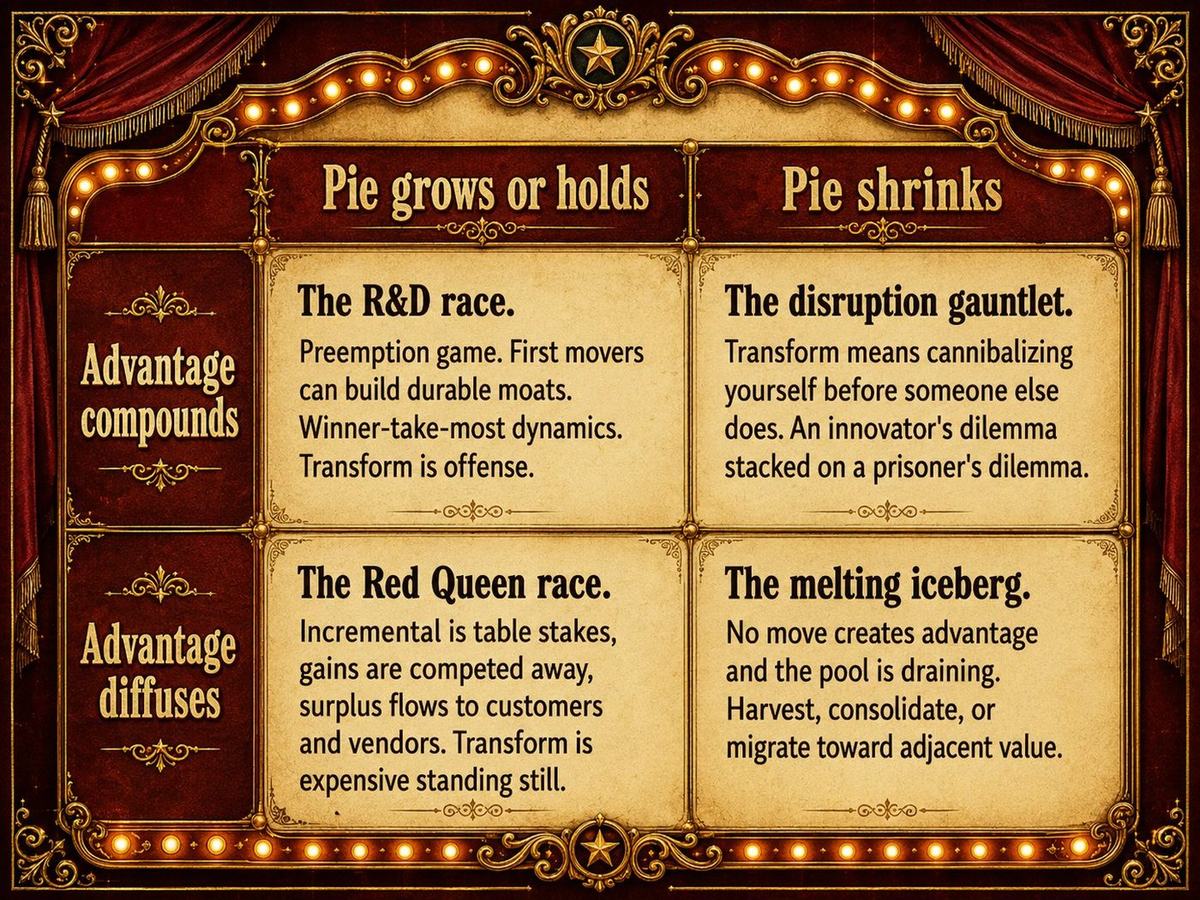
Look at what the matrix says about investment:
-
In the R&D race, heavy investment is offense
-
In the disruption gauntlet, heavy investment is survival
-
In the Red Queen race, sustained investment is the mandatory ante
-
Only the melting iceberg - the one quadrant where the pool is draining and nothing compounds - says redirect the capital somewhere else
Three of the four games resolve to “keep spending” and most imply spending heavily is the game theory optimal move.
Most AI strategy debates are people in different quadrants talking past each other. “Move fast or die” is correct in the top-left but value destroying in the bottom-left. “AI is overhyped and the ROI is not there” accurately describes the bottom-left equilibrium and fatally misreads the top-right.
The prerequisite for any AI strategy is diagnosing the quadrant.
Timing: preemption versus the war of attrition
The quadrant determines not only how much to invest but WHEN to invest, because compounding changes the shape of the game.
When advantage compounds, the top row of the matrix, adoption is a preemption game. The payoff of moving first is not just a period of excess returns before rivals catch up. It is securing a position rivals may never catch, because the lead is self-reinforcing.
In preemption games, optimal behavior is to move earlier than a naive NPV calculation suggests because the payoff to being early is asymmetric with the payoff to being late.
We’re seeing some anecdotal evidence of this with a relationship between AI adoption and growth.
When advantage diffuses, the bottom row of the matrix, the timing game inverts into something closer to a war of attrition. Being first mostly means paying the pioneer tax - immature tooling, expensive lessons, organizational scar tissue - while fast followers integrate the settled playbook at half the cost.
So then why doesn’t Watch work as a strategy? Two reasons:
-
The rational fast follower approach is not to watch, it is to pay the incremental ante and begin instrumenting workflows and building the organizational muscle to move fast when the diffusion playbook is clear.
-
There is option value in being ready to Transform if the dynamics change. If you misdiagnose the quadrant and advantages actually do compound while you watched, then you risk being the next Blockbuster and we know how that turned out.
The important variable that governs whether following works is catch-up cost: if diffusion is fast, vendors are eager to sell rivals the same capability, and switching costs are low, then deferring the heavy spend is cheap and rational.
That means the next step in your AI strategy, after determining your quadrant, is building an honest, evidence-based view of catch-up cost in your own industry: how fast do AI capabilities diffuse to competitors, and what, if anything, cannot be bought later?
Scale matters: the game is not symmetric
Classical game theory assumes players choose freely from the same strategy set. This game does not work that way, and scale asymmetry is becoming a competitive weapon in its own right.
To play the Transform move, you need to be honest about the amount of capital and organizational capacity you have to see it through.
Serious transformation means multi-year spending on infrastructure, talent, and process redesigns before much of the payoff arrives, and firms with strong balance sheets and cheap capital can simply outlast rivals through the unprofitable middle of the curve. Capital access is a structural advantage that smaller competitors cannot match in the Transform move.
Just as important as capital is organizational capacity to transform - leadership that actually understands the technology, an operating culture that can absorb workflow redesign, and the political ability to move people and budget away from the legacy operating model.
This asymmetry changes rivals’ best responses. If you know a competitor cannot afford the Transform ticket, their options are reduced to Watch or Incremental and you can plan against that.
Conversely, if you are the capital-constrained player in a compounding industry, your realistic strategy set does not include winning the transformation race, and pretending otherwise is a good way to destroy value.
The realistic alternatives for a capital or organizationally constrained enterprise are:
-
Focus: Transform one slice of the value chain where proprietary data or customer intimacy creates a local compounding loop
-
Alliance: Attach to a platform’s compounding curve rather than building one - with eyes open about how that learning curve is visible to the platform
-
Timed exit: Sell into the consolidation wave while strategic buyers will still pay for industry assets
Notice that even the constrained player’s menu is made of investment strategies, not purely standing by on Watch mode.
The longer the game, the bigger the ante
In each turn of the game, the technology continues to improve. Model capability, agent reliability, and cost per unit of intelligence are all moving fast enough that an optimal strategy in 2026 can be a disastrous position by 2028.
Tasks that made the Transform move look reckless two years ago - deploying agents for customer-facing work, using coding systems to manage production systems - have become generally accepted practices.
For enterprise strategy, the direction is clearly moving towards greater levels of feasibility across the org and that strengthens the case for staying at the table and at least paying the ante.
The bear case implicitly models AI spend as a fixed cost chasing a fixed return. In reality both sides of that ratio are moving in the enterprise’s favor: capability per dollar rises every round, and the set of workflows where agents clear the reliability bar keeps expanding. This is the profile of a toll that keeps converting into greater option value.
In a game where payoffs drift in a predictable direction - capability up, cost down - the meta-strategy is to keep paying the ante to build positions that gain more option value across many future matrices rather than optimizing for the current one.
Just because a company is in the “melting iceberg” quadrant today doesn’t mean the capability and cost curves won’t change those dynamics in the future.
That means the move is to acquire the assets that appreciate no matter how the game evolves. Proprietary data in usable form. Workflows instrumented well enough that agents can be dropped in when they become reliable. Organizational fluency with the technology. And an orchestration layer decoupled from any single model, so your evals, routing, and institutional memory stay yours while the models underneath stay swappable.
So the right way to size an AI budget is as three stacked components.
-
The ante: the defensive spend that keeps you at the new productivity frontier, mandatory in every quadrant.
-
The option premium: instrumentation, data assets, and organizational fluency that appreciate as the matrix shifts.
-
The transformation bet: transformation capital, deployed only where your quadrant and your seat say it can compound.
Firms that spend the ante and skip the premium are standing still expensively. Firms that place the bet without diagnosing the quadrant are being irresponsible with capital. The optimal play for most firms is all three components, sized accordingly, and this is bullish for continued AI investment.
Part Two: Four industry archetypes, four games
In part two we look at how the game theory framework from part one applies across four different industry archetypes.
One caveat before diving in: these archetypes contain generalizations, and a firm’s position within its industry can shift its quadrant relative to the archetype’s center of gravity. Treat these as starting points.
Spoiler alert: as we go through these archetypes watch how the “keep investing” conclusion holds up. Three of the four archetypes demand transform-level spend and the fourth still pays the ante.
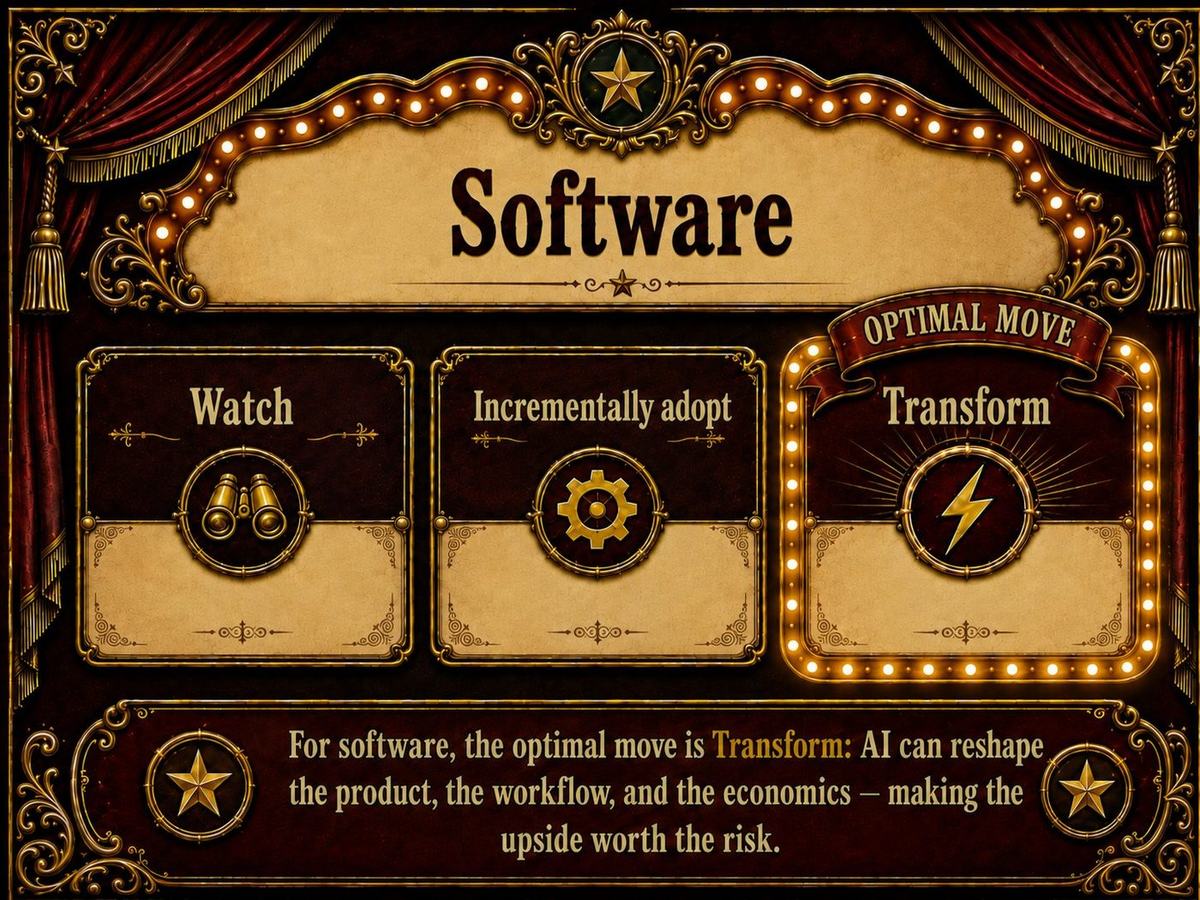
Software: the two-front war
Software is the only archetype where AI attacks both the operating model and the product at the same time, which puts it in the most violent position across industries.
On the operating model, agentic coding is compressing software-development timelines and collapsing the cost of building software. This is a compounding-rich environment.
Firms that rebuild engineering around agents ship faster, and shipping faster in software translates directly into product advantage, which funds the next capability gap.
The Red Queen analysis has already reached this sector - S&P Global argues AI is shortening the expected lifespan of software moats, and investors are compressing the horizon over which they credit software firms with excess returns.
When an entire industry’s cost of production drops an order of magnitude, incumbency advantages built on accumulated engineering effort deflate with it.
On the product side, it is a more existential problem. The pie effect in software is genuinely ambiguous, and for some segments it is negative.
A meaningful share of SaaS exists to sell workflow automation to enterprises. As those enterprises acquire AI capability of their own, the build-versus-buy calculus shifts, and the marginal SaaS product competes not just with rivals but with its customer’s ability to have agents build a good-enough internal version.
Not every category faces this. Systems of record with deep data gravity and compliance moats are far more protected than point-solution workflow tools (I touched on this in an earlier article). But the threat redraws the game. Software incumbents are playing preemption against each other while simultaneously playing a defection game against their own customer base.
In Software, the Watch move is nearly unplayable because the diffusion speed of agentic development is high and the pioneer tax is low.
The incremental move of adopting coding assistants while leaving the product and business model untouched is a slow bleed because it concedes both fronts.
The strategic action is to Transform, and specifically to transform the product around the things customers cannot recreate by prompting - proprietary data and workflow position - paired with a production-side rebuild.
Software firms that transform only their engineering process are optimizing the operating model of a product whose category may be dissolving. For this archetype it’s more about survival and “the ROI isn’t there yet” is not a reason to slow down.
Discovery businesses: the R&D race
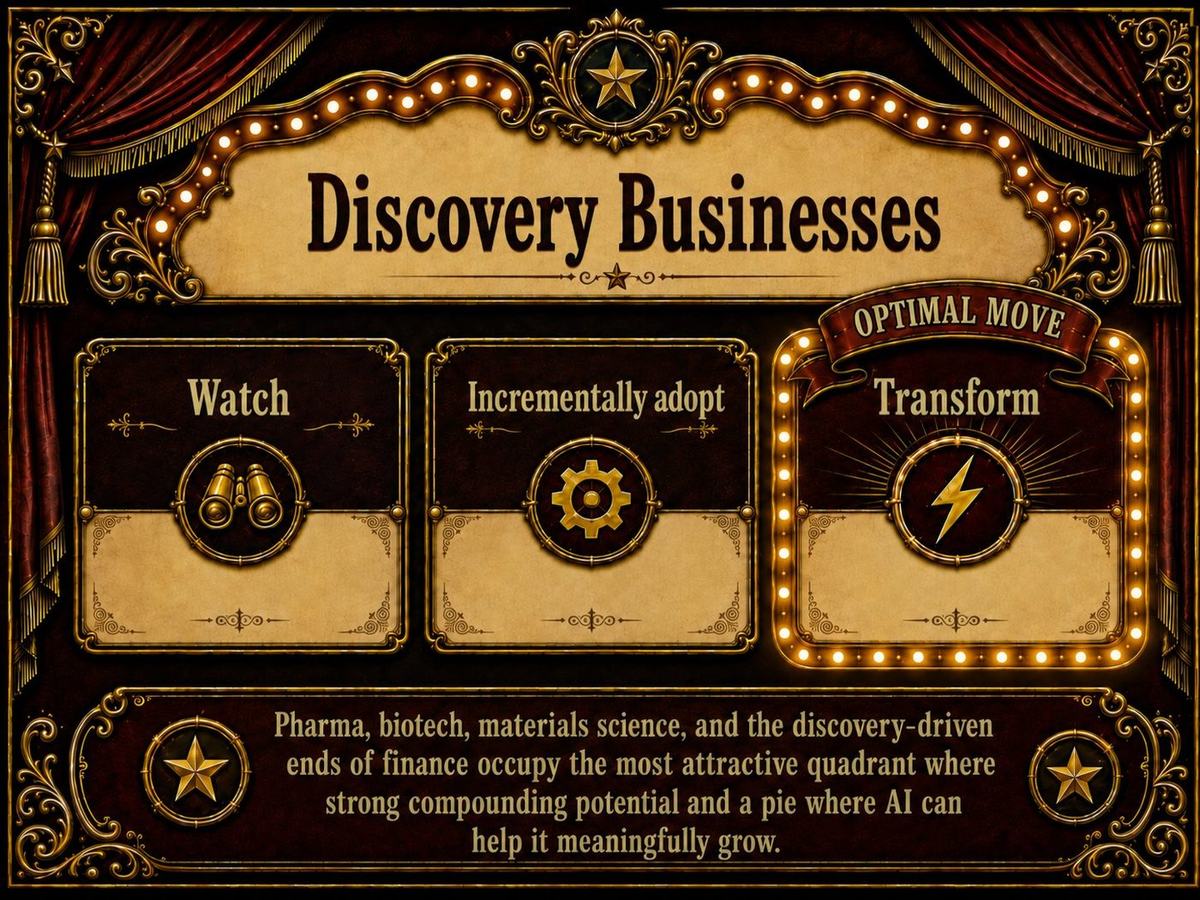
Pharma, biotech, materials science, and the discovery-driven ends of finance occupy the most attractive quadrant with strong compounding potential and a pie that can meaningfully grow from AI adoption.
In this archetype AI provides a shot at compressing discovery itself leading to faster molecule identification, better trial design, novel materials, and new alpha in financial markets.
Compounding here runs through proprietary data, and this is where the scale asymmetry mentioned in Part One hits the hardest.
The large player is in an R&D race where preemption logic applies with full force. Move early, build the data flywheel, and the advantage feeds itself, with winner-take-most dynamics.
The subscale player is functionally in a diffusing-advantage game and should play accordingly - focus on a data niche the giants ignore, partner with a platform, or become an attractive acquisition.
The distinctive characteristic of this archetype is that the prize in a discovery domain largely goes to whoever gets there first, which drives rational overinvestment at the top end.
When you see a pharma major’s AI budget and wonder where the ROI case is, this is the answer: the ROI case is the race itself. For everyone outside the top tier, the strategic priority is refusing the temptation to run a race you cannot win, and instead finding the niche where your data makes you locally unbeatable or become an attractive acquisition.
Asset-heavy industrials: the rational fast follower in a Red Queen race
In manufacturing, energy, transportation, mining, and utilities, the physical asset base rate-limits AI leverage, and that changes the equilibrium.
AI can optimize around the assets - predictive maintenance, logistics, scheduling, design, and procurement - and the gains are real, often worth full points of margin, but intelligence does not substitute for the smelter, the fleet, or the grid. Value creation runs through atoms, and atoms cap how much abundant intelligence can restructure the business.
Across our two dimensions, compounding is modest and the pie is stable to mildly growing. Optimization advantages diffuse through the vendors, integrators, and talent that every major industrial shares, and AI does not devalue the core asset or unlock dramatic new demand.
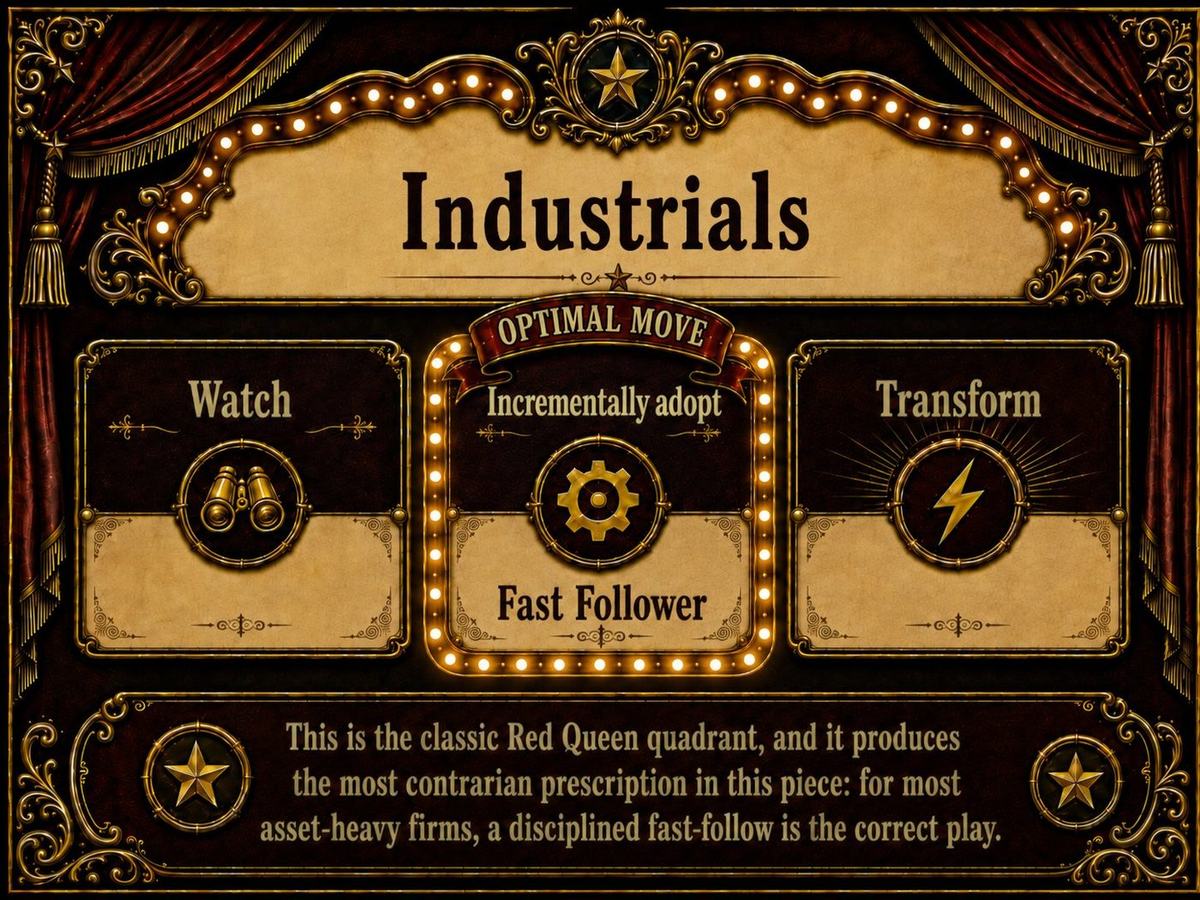
This is the classic Red Queen quadrant, and it produces the most contrarian prescription in this piece: for most asset-heavy firms, a disciplined fast-follow is the optimal play.
Let the leaders pay the integration tuition, let the vendor ecosystem mature, then adopt the settled playbook at a fraction of the pioneer’s cost. The catch-up cost that makes waiting fatal elsewhere is lower here because the channels of diffusion are strong and the compounding loops are weak.
But don’t let this validate the bear case because the rational fast follower is paying the ante and the option premium the whole time - pilots deployed, workflows instrumented, data pipelines built, teams fluent - and deferring only the transformation capital until the playbook settles.
Its AI line item grows every year. What it avoids is the pioneer tax, not the game.
Two exceptions:
-
Firms that can convert operational data into a sellable capability - the industrial that turns maintenance data into a service business or a software product can escape the quadrant by changing what they sell, effectively migrating toward the discovery archetype
-
In commodity industries with steep cost curves, even a diffusing advantage is worth having during the window it exists, because a few quarters of superior cost position in a downcycle can put a firm into an acquirer vs acquiree position
The fast-follow move is about not overpaying to be first. It is not a license to be last.
Professional services: the disruption gauntlet
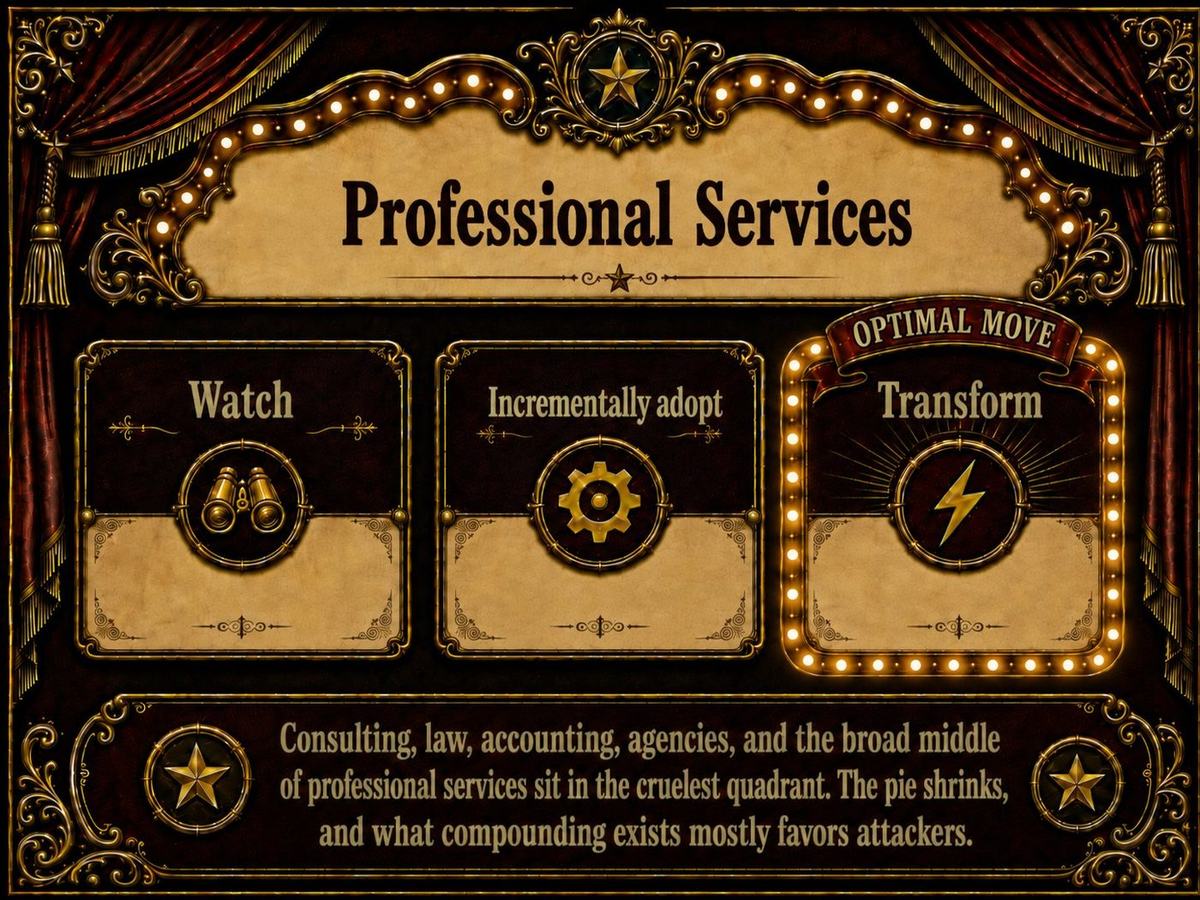
Consulting, law, accounting, agencies, and the broad middle of professional services sit in the cruelest quadrant. The pie shrinks, and what compounding exists mostly favors attackers.
This archetype’s game is being documented in real time with the Big Four accounting firms and large law firms publicly wrestling with pricing as AI compresses weeks of analyst work into hours, and legal-industry surveys showing clients moving from hourly billing toward fixed-fee and outcome-based arrangements.
The structural problem is precise: these industries price on human time, and AI makes the priced input abundant. Every efficiency gain is simultaneously a revenue leak.
The structure is an innovator’s dilemma stacked on a prisoner’s dilemma.
The innovator’s dilemma layer is internal. Transforming means cannibalizing your own billable-hour revenue and gutting the leverage pyramid of juniors whose marked-up hours fund the partnership, so every firm has a powerful incentive to defer.
The prisoner’s dilemma layer is external. If all incumbents defer together, the pricing umbrella holds for a while, but each firm is individually better off defecting, using AI quietly to cut delivery cost while pricing against the industry’s old cost curve.
And unlike the textbook dilemma, this game has an outside player who forces the defection - the AI-native entrant, with no pyramid to protect, no partners to placate, and a cost structure built on agents from day one.
That entrant changes the incumbents’ payoffs decisively. Holding formation does not preserve the pie, it just makes the pie easier to eat by the AI-natives.
So the equilibrium path for serious incumbents is forced transformation on defense.
Shrink your own revenue per engagement before someone else shrinks it for you, and race to rebuild the model around what stays scarce when execution is abundant - judgment, accountability, relationships, regulatory standing, and proprietary methods encoded into agents.
Note that this list is exactly the institutional know-how that needs to be well guarded: a services firm that transforms by feeding its distinctive judgment into the same model its rivals rent has cannibalized itself and donated the remains.
In this archetype, AI investment does not merely fail to produce ROI - it produces negative revenue in the near term, by design, because the alternative is watching an entrant take the whole pie.
The firms that navigate this will look smaller by revenue and better by margin, selling outcomes delivered by a far higher ratio of agents to humans.
Closing: the show must go on
If we put everything together, looking at the 2x2 quadrant and the optimal strategy for each of the 4 industry archetypes, it becomes pretty clear that most scenarios result in continued, or increasingly scaled up, investment in AI. This is the bull case as the show must go on.
The part that most people misunderstand is that the current lack of ROI does not validate the bear case, it is the expected outcome at this stage through a game theory lens.
Games like this do not end when the average player fails to achieve ROI. They end when players can no longer pay the ante, or when the game itself changes. Neither is on the horizon.
The ante is mandatory in every quadrant but one and in all four of the profiled industry archetypes, the ante gets bigger over time, and the scenarios where Transform is the optimal move is the majority.
And if the existing industry dynamics are not convincing enough, just remember that AI-native entrants, who never face the Watch-Incremental-Transform choice at all, are coming for most industries. They are born transformed with no legacy revenue to cannibalize. That means where entry barriers are low, especially software and services, the incumbents cannot just quietly agree to adopt slowly and protect the revenue pool.
The uncomfortable truth for adopters is that many of them will never see the ROI in their own P&L, because the equilibrium hands the surplus to customers and vendors. The uncomfortable truth for the AI bears is that this changes nothing about the spending, because the game punishes leaving far more brutally than it rewards staying.
None of this means every dollar of AI spend is well spent - that is a discussion for another article, but until then the show must go on!
If you’re an enterprise leader and want to discuss AI strategy, my DMs are open.