Proof of Useful Work: Make Mining Great Again
TLDR; with Pearl Network and Nockchain getting a lot of attention lately, “Proof of Useful Work” has become a hot topic again, so I dug deep to lay it all out for you - from the history of the term, the complexity behind it, and the 6 notable projects building PoUW solutions.
I first heard the term “Proof of Useful Work” (PoUW) when I got introduced to Ambient (a Delphi Ventures portfolio company) a few years ago. The idea immediately made sense to me - instead of doing computations for the sake of it, do something useful like run AI inference.
Lately there’s been a lot of talk about PoUW so I decided to dig deep to understand the nuances of PoUW (spoiler: it’s more complex than you may think) and I researched every project I could find that is doing some variation of PoUW.
This is a plain-language primer: what PoUW actually is, the architecture that defines it, why it’s so technically hard, the 6 notable projects building PoUW solutions, and where I land after going deep on the topic.
First, what makes work “useful”?
Bitcoin’s mining is often described as computers “solving pointless complex math.” That’s true but it misses the point. The puzzle they solve is deliberately pointless - find a number that, when you scramble it, comes out with a bunch of leading zeros. There’s no use for that number. It answers no question. Nobody wanted it solved.
The pointlessness is the entire feature. It’s buying something real: a settlement system no government or company can quietly censor or rewrite.
Proof of Useful Work asks the obvious follow-up question: what if that same energy did something with a positive side effect like trained an AI model, ran AI inference, solved a real optimization problem, or stored real data instead of just grinding pointless numbers? In other words, is it possible to get both security and a useful byproduct?
It’s a beautiful idea, and despite all the recent timeline chatter, it’s actually a relatively old idea. Before we get to who’s building it today, it helps to know where the concept came from.
A short history: where “useful work” came from
Proof-of-work was actually invented prior to crypto, then Satoshi made it famous. But as I’ve recently learned, shortly after Bitcoin came out people began asking the obvious question - if we’re burning all this computation anyway, could it be doing something useful?
A 1999 paper even coined a name for recycling that effort: “bread pudding protocols,” after the dish that repurposes stale bread.
The first project to actually ship it was Primecoin. Instead of grinding meaningless hashes, Primecoin miners hunt long chains of prime numbers which is genuinely useful to mathematicians, but the downside is that there’s not much business value in prime number hunting.
Then came a wave of well-meaning “mining for science” projects from 2013 to 2017 like Gridcoin, Curecoin and Foldingcoin.
What we found out is that doing useful work is easy, doing it as the thing that secures the chain is brutally hard.
The theory finally caught up in 2017, in the paper that put the term on the map: “Proofs of Useful Work”. It was the first to cleanly reconcile the two properties that had only ever been achieved separately - work that’s reliably hard enough to secure a chain, and work that’s genuinely useful to somebody.
Nearly every project in this article is a descendant of that paper.
So the concept is more than a decade old and the theory is sound, it’s just that turning it into a live, secure blockchain has taken some time.
Two different ways of architecting PoUW
Almost all confusion about “proof of useful work” goes away once you split it into two architectures that oftentimes get lumped together.
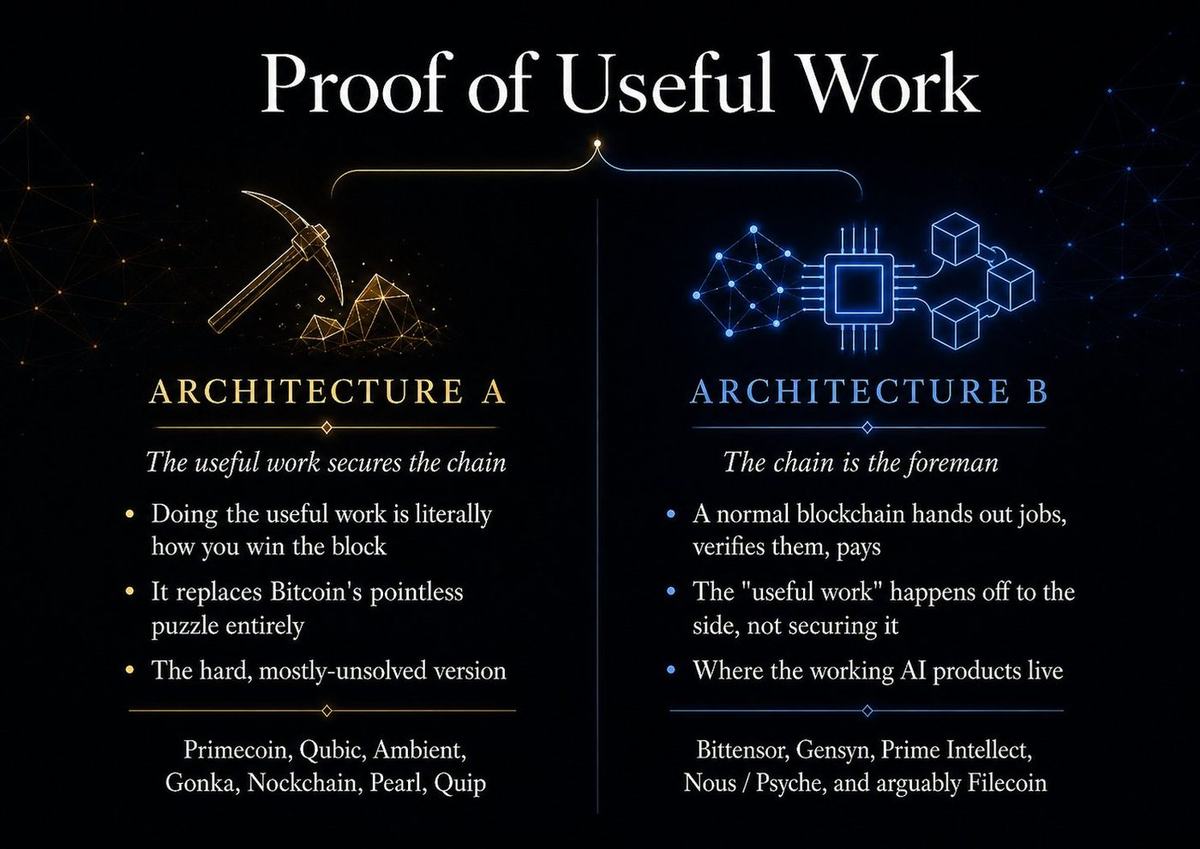
Architecture A - the useful work secures the chain. Here the useful computation actually replaces the pointless puzzle. Doing the work is how you win the right to produce the next block. This is the literal hard version of PoUW, and it’s where the deep unsolved problems live.
Architecture B - the chain is a foreman. Here a perfectly normal blockchain (usually a proof-of-stake one) sits to the side and acts as a marketplace foreman: it posts jobs, hands them to workers, checks the results, and pays out. The “useful work” - training a model, running inference - happens off-chain. The blockchain never uses that work to secure itself, it is used as a coordination and settlement mechanism.
Architecture B has a much wider design canvas due to the “useful work” happening off-chain and not what I’d really consider PoUW, but it’s important to understand the distinction as I found many to conflate the two architectures when I was doing my research.
Architecture A is the true form of “we fixed Bitcoin’s waste” - and it’s brutally hard, which is why so few projects have shipped it. This is the primary focus of this article.
Why Architecture A is so hard: the verification problem
To replace Bitcoin’s pointless puzzle, your useful work has to behave like that puzzle in five specific ways. It has to be: 1) hard to produce, 2) easy to check, 3) tunable in difficulty, 4) started fresh each round (no permanent head start), and 5) tied to the specific block so it can’t be precomputed or reused.
The one that makes PoUW the hardes is being easy to check.
Bitcoin’s puzzle is trivial to verify. Every computer on Earth can confirm it in a millisecond. But useful work is usually the opposite. If a miner claims “I just ran this AI model and here’s the answer,” how does the rest of the network confirm they actually did it, and didn’t just make something up?
The naive answer - have everyone re-run the work to check - defeats the entire purpose. You wanted to save the energy, not spend it ten times over. Worse, modern GPUs don’t even produce identical results for the same calculation, so two honest computers running the same AI model can disagree on the last few digits, and now you can’t tell honest disagreement from cheating.
There have been various attempts to solve this and each come with trade-offs:
-
Re-run it (replication) - have several computers do the same job and compare. Dead simple, but wastes the savings you were chasing
-
Trust-but-challenge (optimistic) - we know this method from PoS design, assume the worker was honest, but let anyone dispute it; if they do, you only re-run the one contested step. Cheap when everyone’s honest, but there’s a delay before anything is final.
-
Math proof (zero-knowledge) - the worker generates a cryptographic receipt proving they did the work correctly, revealing nothing else. The gold standard for trust, but for big AI models, producing that receipt is still incredibly slower than just running the model, so it’s not practical at frontier scale (yet).
-
Secure hardware (trusted enclaves) - run the model inside a tamper-proof chip that vouches for the result. Fast and cheap, but now you’re trusting the chip maker, and those chips have been broken before.
-
Spot-checking (sampling) - randomly re-verify a fraction of the work and set the penalties so cheating never pays. Cheap, but it’s a statistical argument, not an ironclad proof.
The two most notable newer approaches are worth singling out because they power the most interesting PoUW projects:
Proof of Logits. When an AI model generates text, at every step it produces a fingerprint - a set of internal numbers (logits) that’s extremely hard to fake without actually running the model. The verifier just spot-checks a few of these fingerprints at random positions. Cheap, no delay. The catch is that it’s a clever statistical method, not a hard mathematical proof. Proof of Logits is the foundation of the Ambient project profiled later in this article.
Provable matrix multiplication. Every AI model, underneath, is mostly one operation repeated trillions of times: matrix multiplication. In 2025 a group of cryptographers (Komargodski and co-authors) cracked a long-standing open problem - how to let a miner do real matrix multiplication and produce a cheap cryptographic proof that they did it honestly, with almost no overhead and no way to game it. This matters more than it sounds, because matrix multiplication is the literal thing AI runs on. It’s the first time anyone turned “mining” into “useful AI math” with a real proof attached rather than a statistical guess. It’s the foundation of the Pearl Network project profiled later in this article.
That’s the whole technical core of it. Proof of Useful Work sounds simple on the surface - sure, just have the computers do some AI work, but its not that easy and takes some gigabrains to figure it out.
The important questions underlying the PoUW thesis
It’s easy to get mesmerized by the tech or the cleverness of the mechanism and forget to ask whether anyone needs the output of a PoUW network in the first place.
The bet is not “will people want to use these blockchains?” We know that block space is abundant and cheap so a PoUW network really only sells one thing that matters: the useful work itself - the inference, the training, the optimization answers, etc.
Assuming the work is actually useful, the key question becomes: why not just run the computation normally? E.g., why do you need a blockchain?
Let’s consider decentralized AI inference. The decentralized network has to compete against the centralized providers or the option of renting GPUs and running the model yourself: cheaper (without incentives), faster, and no token attached.
For the crypto version to win, people have to want the work done not merely as compute but in a trust-minimized form - verifiable, censorship-resistant, neutral, with trustless payment and no company that can rug you - and want those properties enough to pay a premium for them.
Call it the decentralization tax. The hard question then becomes “is there demand for inference that’s worth paying the decentralization tax for.” That slice of the market is real, but today it’s relatively small. How fast that TAM grows as trust in centralized AI erodes is, honestly, the single most important variable for the whole sector.
There’s also a second, deeper problem, and it’s the one I find most interesting because nobody has solved it.
The trap: security eats usefulness, or usefulness eats security
Every project in Architecture A sells the same flywheel:
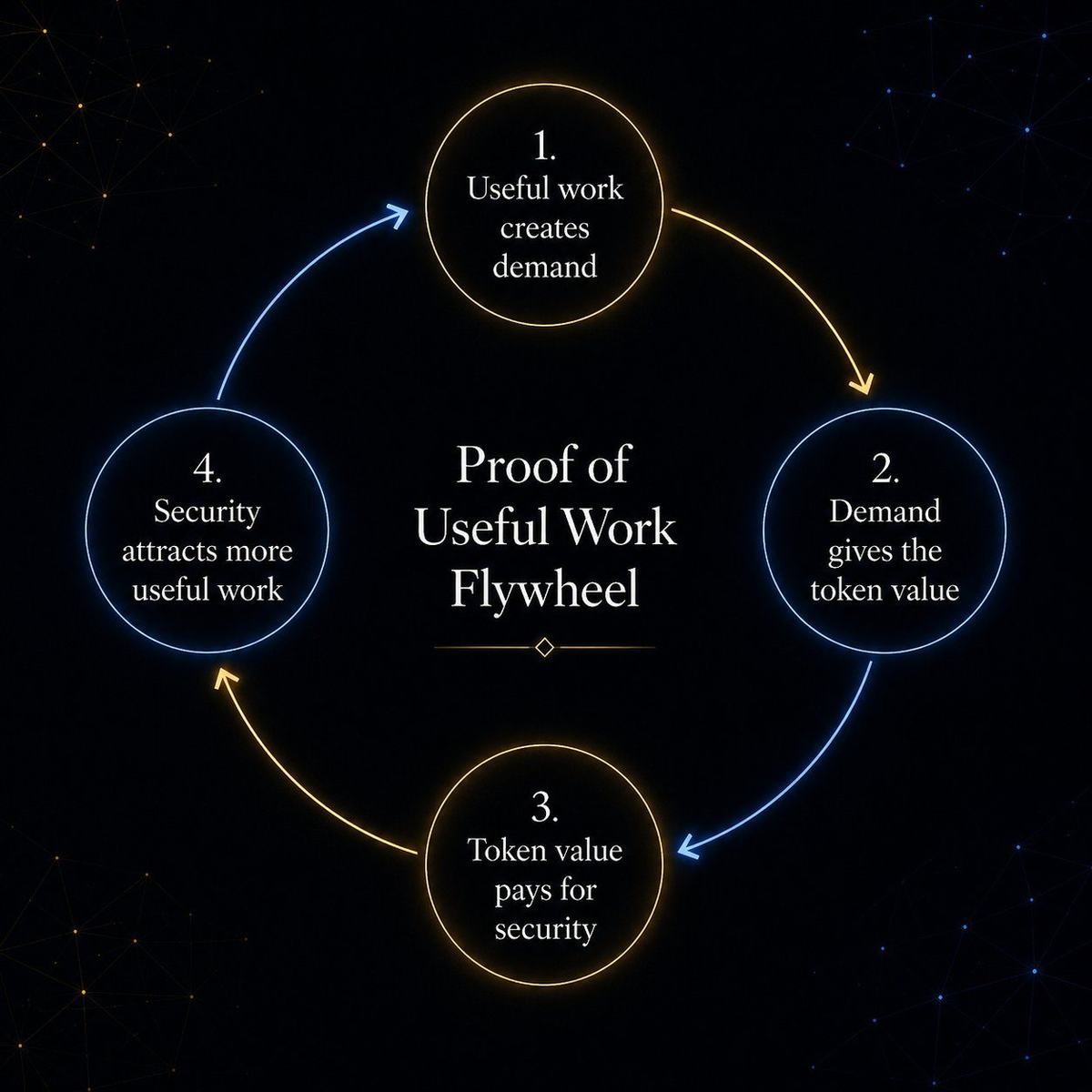
It sounds good, but if you look closely the two halves quietly cannibalize each other.
If the useful work has real outside demand and a real price - someone’s paying cash for those AI answers or those proofs - then miners increasingly get paid in that outside money. The more successful the useful-work business becomes, the more the token becomes a functionless coupon that miners don’t really need. But the token was supposed to be the thing capturing the value and securing the chain right?
If instead the token is what secures the chain and soaks up the value, then security rides on the token’s speculative price, not on how useful the work is. Which is exactly the old “if the token dips, the chain gets insecure” problem - and it means the “useful” part isn’t actually holding the security together at all. It’s regular proof-of-stake wearing a useful-work costume.
The more clear each half gets, the more pointless the other starts to look.
Threading that needle where useful-work revenue and token security genuinely reinforce instead of undercutting each other is the core unsolved problem of the entire category.
I haven’t seen anyone fully crack it, but this isn’t a reason to write the category off. It’s just something that will need to get solved and speaks to the earliness of the category.
The 6 Architecture A projects profiled
Now for the projects themselves - the ones betting that the useful work is what secures the chain.
Pearl Network / Pearl Research
Pearl Research Labs (token: PRL, only available via OTC exchanges as of this writing, trading at $1.5-2 billion FDV) launched its own Layer-1 blockchain in late April 2026 as “the Bitcoin of the AI compute era.”
What makes it stand out is that its reference miner is built on vLLM - a standard high-performance inference engine used by all the serious inference providers, and ships with a ready-to-run LLaMA 3.3 70B model.
In other words, a Pearl miner is also a working AI inference server. It runs on datacenter-grade NVIDIA GPUs (H100/H200).
Here’s how it works. Pearl’s mining is matrix multiplication - the single operation all AI runs on. A miner does structured matmuls on its GPU, and on the rare occasion it produces a winning result, it wraps that work in a compact zero-knowledge proof (built with a system called Plonky2) that any node can check in milliseconds.
The clever efficiency trick is that the expensive proof only gets generated on that rare winning event, so the cost averages out to almost nothing.
This is the project built directly on the 2025 matrix-multiplication breakthrough from earlier in the article, which is why its verification is a real cryptographic proof rather than a statistical guess. This is what makes it truly unique, and I would speculate the reason why its valuation is so high despite it being so early.
And because the mining math overlaps with genuine inference, the same GPU can mine and serve customers at once for only about 10 percent more in cost. That’s the closest we’ve got yet to a “2-for-1” pitch of being useful and securing a network.
The real validation for Pearl, however, lives on the demand side. Pearl’s attention-grabbing traction is a recently launched partnership with Together AI - a big name inference provider - but the pricing discount for the Pearl-offered model is subsidized by PRL token emissions.
And we know a thing or two about subsidized demand in crypto land, so this is one to watch. Subsidies that win users who stick around are a legitimate way to bootstrap a market, so the test is whether the demand survives once the subsidy tapers. At $1.5-2 billion in valuation that’s a big bet.
Ambient (pre-token) is a Layer-1 built as a fork of Solana’s high-speed architecture and founded by Travis Good who previously built the first mathematically optimal freight-rail planner and worked in AI drug discovery and Max Lang (CTO, ex-Microsoft and Amazon).
Ambient raised a $7.2M seed led by a16z’s crypto in early 2025 (Delphi was also an investor). The tagline is “Machine Intelligence as Currency,” and the founders are refreshingly blunt that they see it as a would-be “replacement for Bitcoin” and a “decentralized competitor to OpenAI.” This was the project that first introduced me to the whole PoUW idea.
The work Ambient’s miners do is verified AI inference - but on a single, fixed, network-owned model (600B+ parameters, in the DeepSeek lineage). Verification uses the Proof of Logits method outlined earlier in the artice: every token the model generates carries a hard-to-fake fingerprint, and verifiers spot-check a few of them at random for roughly 0.1 percent overhead (very efficient). Miners earn Bitcoin-style block rewards in the form of newly issued coin plus fees.
The whole thing rests on one deliberate, contrarian bet: one model, not a marketplace.
Most crypto-AI projects let you run any model; Ambient argues a marketplace destroys miner economics because you can’t keep a thousand different models loaded in GPU memory at once.
So it points the entire network’s compute at a single model that improves continuously.
The real bets here are that Proof of Logits, despite not being a hard cryptographic proof, and the one model approach will pay off. I’m a big fan of the team and what they’re doing, but consider me biased.
Nockchain (token: NOCK, traded on Base, ~$100m market cap) is a minimalist Layer-1 from a team called Zorp and led by CEO Logan Allen. It’s built on “Nock,” a deliberately tiny 12-instruction computing model, paired with a custom zero-knowledge virtual machine the team claims is far more efficient than general-purpose ones. It went live in May 2025 with a 100 percent fair launch - no venture token allocation, no team lock-up, every coin minted by mining.
Mechanically, Nockchain miners don’t hash. They generate a zero-knowledge proof that they performed a fixed puzzle computation, then hash that proof; the more proving power you bring, the more you earn. The only thing that ever lands on-chain is the small verified proof, which keeps the chain light while the heavy lifting happens off to the side.
What’s genuinely useful is that it subsidizes and commoditizes zero-knowledge proving capacity - it bootstraps a market and a cheap foundation for verifiable computation, which the broader crypto world increasingly needs.
But the thing miners prove is a fixed puzzle, not a problem you submitted. So it’s useful in the sense of “building a proving marketplace,” not “miners are doing your homework for you.” It’s a unique and clever way to solve the hard verification problem while remaining legitimately useful in its connection to the work performed.
What we need to keep eyes on here is if real demand for Nock proofs actually materializes. At the current valuation (sub-$100m) and the potential here, this feels like a good bet. Note: Delphi Ventures is long NOCK.
Gonka (token GNK, not liquid or traded on major exchanges, reportedly trading in the $200-300 million FDV range) is a Layer-1 aimed squarely at AI inference with training planned for later.
It comes out of the Bitfury orbit, the well-known bitcoin-mining-hardware company built by the Liberman brothers and championed by Bitfury’s George Kikvadze, whose firm made a fifty million dollar investment in it in December 2025. It launched in August 2025 and within about three months had assembled compute equivalent to roughly 6,000 NVIDIA H100 GPUs.
The mechanism is the cleanest expression of “make the puzzle the work.” Gonka’s proof-of-work task (it calls it “Sprint,” or “PoW 2.0”) is deliberately shaped to mirror the math of LLM inference, so a participant’s mining power directly tracks its real model-serving capacity.
The inference happens off-chain; the chain just records cryptographic artifacts proving the work was done. Rewards flow to the people contributing compute, with no staking layer skimming a cut, which is Gonka’s main pitch against proof-of-stake GPU networks, where (it argues) most of the cycles get spent on consensus overhead rather than useful work.
So Gonka is the most explicit “Bitcoin of AI compute” of the projects: bind the token directly to verifiable inference, no middlemen. The open question is the familiar one - its value depends entirely on real inference demand actually flowing through the network.
This puts Gonka in a crowded and increasingly commoditizing market and the precise details of how cheaply the network can verify that a host genuinely ran the claimed “transformer-shaped” work is still not entirely clear. So still early but definitely one to keep eyes on.
Quip Network (pre-TGE) comes from Postquant Labs (CEO Colton Dillion, CTO Dr. Richard Carback), a team with roots at 0x, Parity, Intel, IBM and the quantum-resistant xx Network. Its public testnet launched in early April 2026, built in consultation with D-Wave, the quantum-computing company, and already reports 20,000+ signups.
Quip is actually two layers sharing one token: a Compute-Consensus Layer (the proof-of-useful-work chain itself) and an Asset Layer that adds post-quantum security to wallets and contracts on other chains.
The mining is the genuinely novel part. Instead of hashes, miners solve real combinatorial optimization problems - logistics, scheduling, finance - routed across a mix of ordinary CPUs/GPUs and actual D-Wave quantum annealing machines.
Solving them both secures the chain and produces answers that can be sold to whoever posed the problem. Optimization works well for PoUW designs as a proposed answer is cheap to check even when finding it was hard. So unlike AI inference, verification here is genuinely easy.
That makes Quip the only project pairing useful-work mining with quantum hardware, aimed at a problem class (optimization) that actually has merit, plus it has the unusual bonus of a post-quantum security product alongside.
But, it’s still in testnet and centrally managed, and its headline energy and quantum-advantage figures are vendor-stated, not independently confirmed. I’m including it in the set as it fits the Architecture A definition, but mostly one to just keep on the radar for now.
Qubic (token: QUBIC, moderately liquid, FDV ~$80m) is a feeless Layer-1 founded back in 2019 by Sergey Ivancheglo a co-founder of IOTA and an original NXT developer. Its useful-work pitch points mining at training neural networks for an on-chain AI project called Aigarth, with an unusually aggressive stated goal of reaching AGI by 2027. A fixed set of 676 validators (it calls them “Computors”) reach consensus each weekly epoch.
In practice, what Qubic’s mining actually does has kept changing, so it’s a bit hard to follow. Early on, miners generated neural networks with random structures which was more exploratory, not something anyone was demanding.
Then it pivoted to an economic model: aim the network’s aggregated mining power at mining other proof-of-work coins, and use the proceeds to buy back and burn the QUBIC token, so it’s a bit “crypto circular” rather than providing a useful service.
Also, that redirectable mining power has a dark side: in 2025 Qubic pointed its aggregated hashpower at the Monero network as a “demonstration” and briefly threatened the network.
So between that and the ever-shifting definition of “useful” I’d file Qubic as more of a tokenomics experiment but I include it here because in my research I found people calling it the original PoUW chain.
Where I land
The honest summary is that the hard technical problem is mostly solved; the hard business problem mostly isn’t.
On the supply side - can mining be made to produce something useful and still behave like a secure lottery? - the answer is increasingly yes. The 2017 theory proved it was possible, the 2025 matrix-multiplication result is a big breakthrough that made it practical for the exact operation AI runs on.
The unsolved problems are mostly on the demand side:
-
How big is the TAM for those who want compute in a trustless form badly enough to pay the decentralization tax - and how fast does it grow as trust in centralized AI erodes?
-
Can anyone design the token so that useful-work revenue and security reinforce each other instead of making each other redundant?
-
Can verification move from “clever statistical method” toward “hard cryptographic proof” without killing performance?
If those get solved, and there’s credible work going on across all 3, then proof of useful work becomes a real pillar of crypto-AI and could be one of the biggest breakout stories over the next 1-2 years given it’s crossover to the broader AI industry.
From an investor standpoint, the teams worth backing are the ones being precise about which problem they’re solving and who is structurally forced to want what they produce. Beware the projects selling “useful work” as a marketing.
I’m definitely keeping a close eye on this category. It’s early, and that’s when it’s most interesting.
Disclosure: Delphi Ventures is an investor in Ambient and a holder of NOCK tokens. I’ve flagged that for transparency since I am part of Delphi, but I currently do not personally hold any economic interests in the projects mentioned in this article and the framing and judgments are my own.
If you’re building at the intersection of AI and crypto with a real product underneath, my DMs are open.