OpenAI and Anthropic Are Services Companies Now
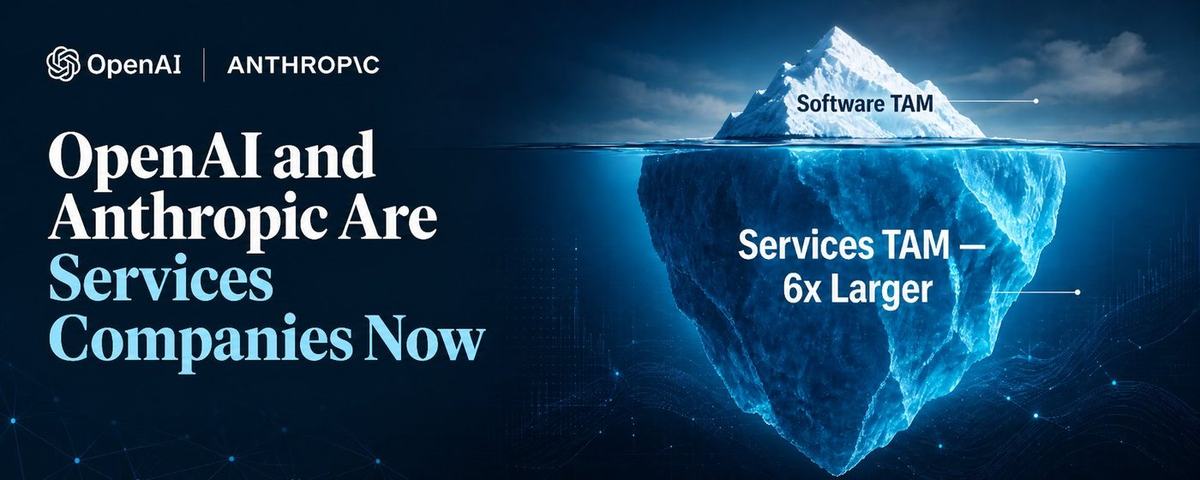
In case you didn’t see the headlines, both OpenAI and Anthropic announced new dedicated enterprise AI deployment companies on May 4, 2026 - the same exact day. In this article I breakdown each deal - how they’re similar and how they’re different - and then what this means for the industry.
Two giant AI deals, one day
Both companies raised billions - OpenAI’s “DeployCo” is a $10B joint venture and Anthropic’s “TBA Co” raised $1.5B. Both deals are anchored by a who’s who of major private-equity companies - TPG and Bain Capital among others with OpenAI, and Blackstone, Goldman and others with Anthropic. Both companies are targeting enterprise deployment.
Here’s a side-by-side of each deal:
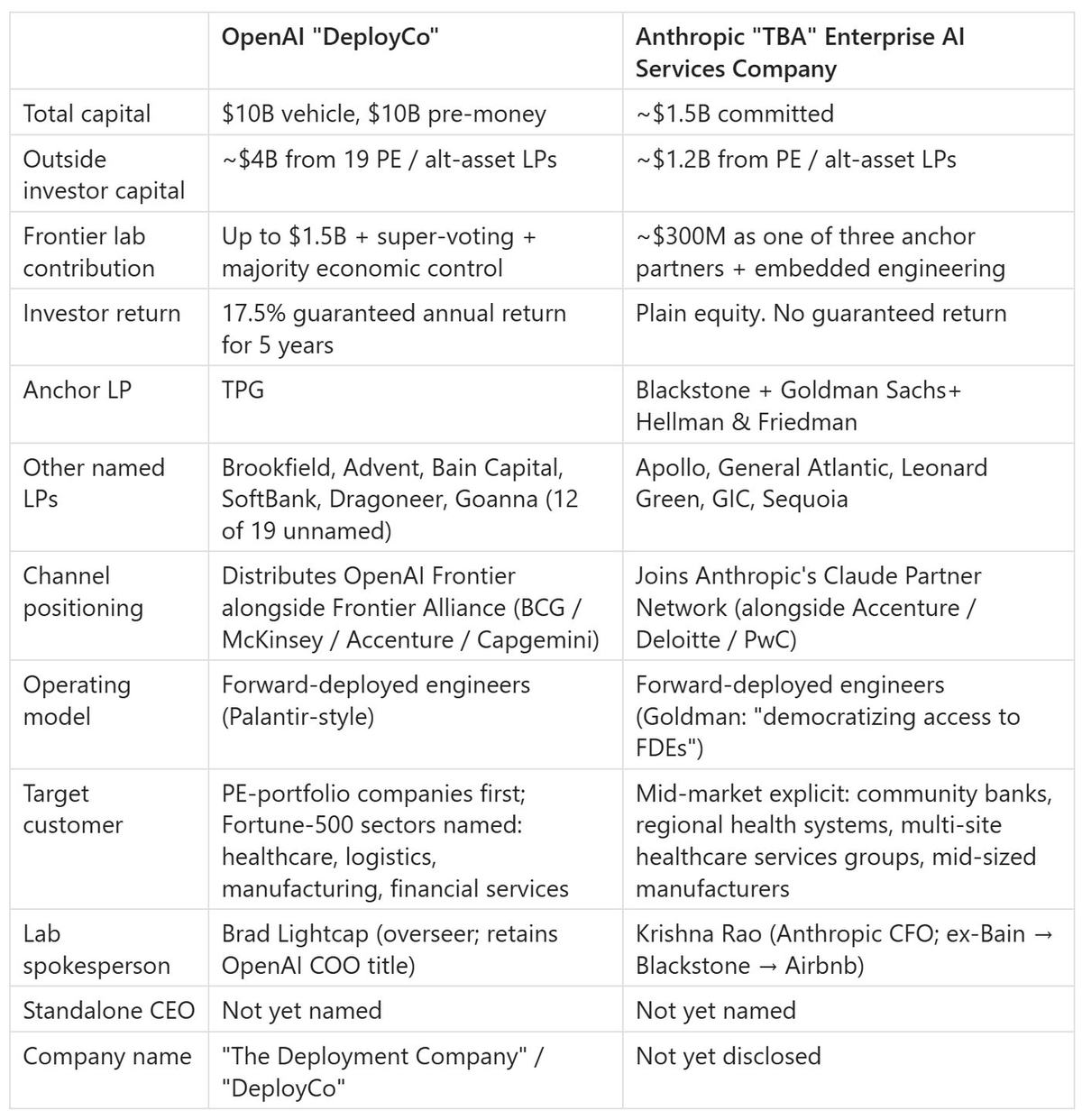
A few additional details that we know thus far:
-
DeployCo is Delaware-domiciled, with the 17.5% guarantee running for 5 years - the cumulative coupon obligation works out to roughly $3.5B on the $4B base, plus return of principal
-
Anthropic’s vehicle is plain-vanilla equity with no guaranteed return - the most striking design difference between the two ventures
-
No CEO has been named on either side. No executive team. No first deployments. Both ventures launched as capital structures first, operating companies second.
-
Krishna Rao is the sole Anthropic spokesperson in the press release. The venture is being run as a finance and strategic-capital initiative, not as an extension of Anthropic’s direct sales motion.
Why OpenAI and Anthropic are doing this
Both labs are confronting the same reality: if $trillion+ valuations are to be justified, then getting deep into enterprise with services is the only revenue path to get there.
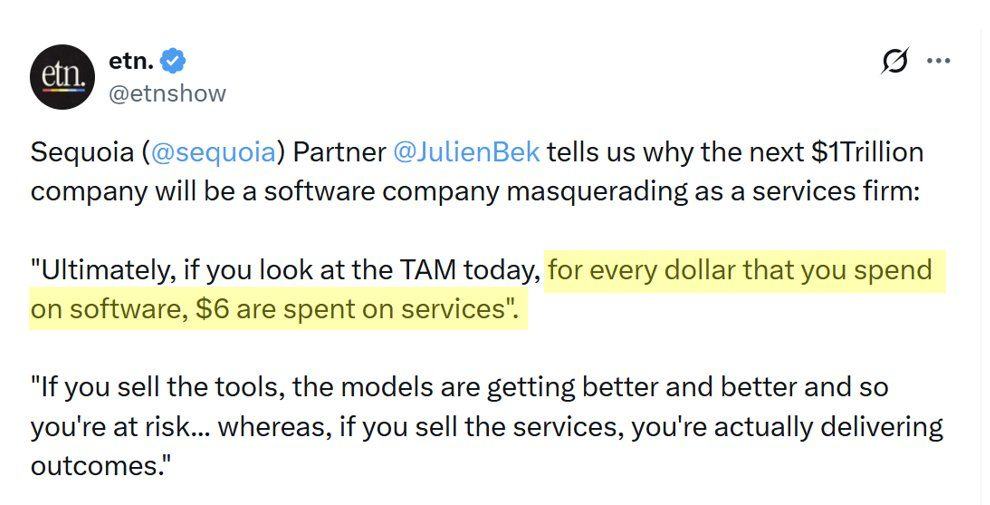
Services is just a much bigger TAM, so it makes complete sense they need to go after this market, and enterprise is where that spend occurs.
However, demand for Claude and GPT inside enterprises is real but uneven. Pilots launch, then often stall in production. Some firms are going all-in on AI usage while many others sit on the sidelines.
The bottleneck isn’t model capability - anyone who’s played with Claude Code/Cowork or Codex knows how powerful the tools now are.
The main issue in getting deeper into enterprise is all the messy big-organization stuff like deployment, integration, change management, IT modernization, workflow redesign, and end-user adoption - all the things that traditional big consulting firms do.
But OpenAI and Anthropic already have big deals with the top consulting firms right? Yes, these distribution channels are a big part of the business - OpenAI’s Frontier Alliance with BCG, McKinsey, Accenture, and Capgemini (announced February 2026), and Anthropic’s Claude Partner Network with Accenture, Deloitte, and PwC.
What the May 4 announcements conclude is that either those partnerships are not scaling fast enough or are insufficiently incentive-aligned with the labs. Likely a bit of both.
The frontier-lab position is now: we know our models are deployable, we cannot rely solely on third parties to deploy them at the speed and quality we need, so we will build (or buy into) native deployment capacity.
OpenAI and Anthropic are coming at it from different angles
Both deals look very similar on the surface, but they’re actually coming at the enterprise market from different angles.
OpenAI is operating under acute financial pressure. $1.4T in cumulative compute commitments. A reported revenue-target miss (WSJ, April 28). A late-2026 / 2027 IPO narrative that needs growth on a faster curve to join the T club.
DeployCo is a clean response to all three: $4B of outside capital comes in immediately, into a vehicle OpenAI controls but doesn’t fully fund. The coupon obligation sits at DeployCo. Frontier-platform licensing revenue flows back to OpenAI.
The PE-LP-portfolio-as-pipeline supplies thousands of guaranteed first-deployment customers. OpenAI is converting future enterprise services revenue into present capital plus a structured coupon. The 17.5% guarantee is the price OpenAI is willing to pay to get cash and pipeline now.
The man assembling these structured deals - Stargate, the Microsoft restructuring, now DeployCo - is Brad Lightcap, who retains his OpenAI COO title but moved to a “special projects” role reporting directly to Sam Altman in early April.
Anthropic is in a slightly different position. The revenue curve is going parabolic with the latest revenue run rate reported at $44B as of April end, up from $30B as of March end, so they don’t need OpenAI’s structured-monetization play.
Anthropic’s strategic logic is about scaling Claude primarily into mid-market segments where many companies lack the in-house AI capacity. Stay complementary to existing system integrators rather than risk channel conflict. Embed engineers rather than transfer them.
The architect on Anthropic’s side is Krishna Rao, the company’s first CFO, and notably an alumnus of both Bain and Blackstone before joining Airbnb and then Anthropic.
OpenAI is engineering a capital-and-coupon transaction. Anthropic is engineering a complementary distribution partnership.
Who wins and who loses with these moves?
Winners
-
PE LPs in the consortia: DeployCo’s 17.5% guaranteed coupon is hard to find anywhere else in 2026. Anthropic’s plain-equity structure gives Blackstone, H&F, Goldman, and the rest of the consortium captive native-aligned AI implementation capacity for their portfolios at preferred terms.
-
PE portfolio companies inside the consortia: subsidized, prioritized AI implementation services from a vendor structurally aligned with their owner’s economics.
-
Forward-deployed engineers: back in my day we were just called “consultants” but now a new $400-$600K total-comp role category emerges at scale. This is the Palantir FDE concept going mainstream.
-
OpenAI and Anthropic: both extend their economic perimeter past pure model licensing into the services layer that captures more durable enterprise value.
-
PE operating-partner roles: operator-DNA at PE firms becomes more valuable as PE firms assume a quasi-distribution-channel role for AI services.
-
Existing SIs that retain their seats: Accenture, Deloitte, PwC, BCG, McKinsey, Capgemini are all explicitly part of the partner networks; not displaced (yet).
Losers
-
Pure-play horizontal harness / agent SaaS: the margins in selling horizontal harness software will get squeezed by lab-aligned services that bundle harness software with deployment expertise, distribution access, and PE-portfolio pipeline. Sorry guys, enjoy it while you can.
-
Mid-tier consulting firms without proprietary methodology IP: many of these will get pushed out on accounts where DeployCo or the Anthropic services co can pitch directly.
-
Independent AI-implementation startups without LP-portfolio access: distribution is king and the PE portcos is a huge distribution edge that OpenAI and Anthropic now have. Good luck competing against a subsidized vendor with a captive client pipeline.
-
Generic fractional CAIOs: the role boomed in recent years but now competes with a structured services arm at scale. Specialists likely survive but the pontificating generalists are not longer needed.
-
PE houses outside both consortia: Imagine being a major PE shop on the outside of these deals. They now need to either build parallel structures or accept being structurally behind on AI-portfolio-enablement. I would expect some parallel announcements within 3-6 months.
Mixed
-
Big 4 / MBB collectively: the firms with proprietary methodology IP and regulated-perimeter positions (McKinsey, Deloitte, EY, PwC) likely continue to do well, but the firms whose value-add is distributing someone else’s platform not so much.
-
Hyperscaler AI services arms: tough to say for Microsoft Industry, Google Cloud Consulting, and AWS ProServe. Their structural advantages remain real, but they don’t have the frontier-lab native-alignment advantage (except Google, but you can only concentrate so much with Google), and they also don’t have the PE-LP-portfolio pipelines. Time will tell on these.
So what just changed?
AI services is no longer a separate category from AI labs. May 4 is the day the labs publicly accepted that deployment is part of their economic model and they’re not messing around.
While the two deal structures are financially different, what is absolutely clear is that OpenAI and Anthropic are going after enterprise in a big way.